
Corns vs. Warts on Your Feet: How to Tell the Difference and What to Do
- May 23, 2026
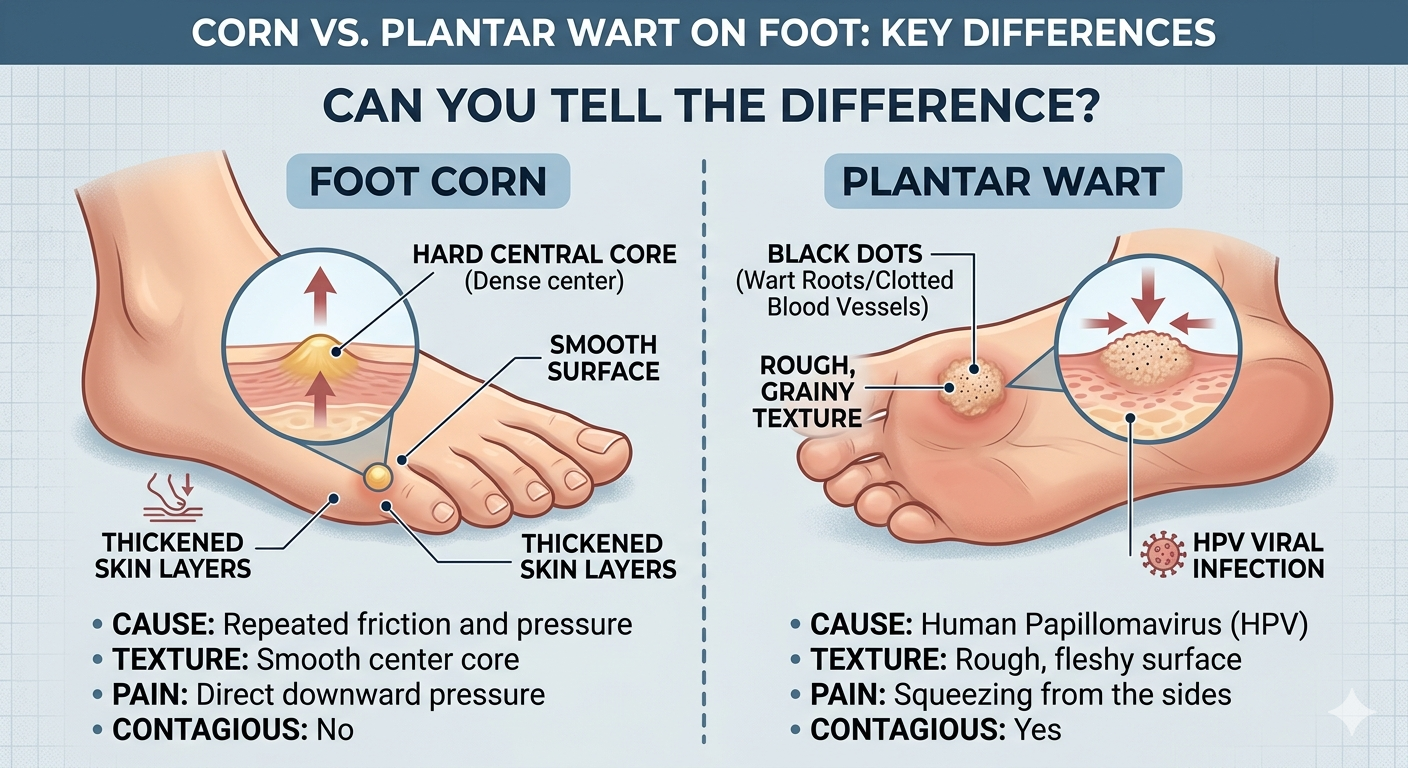
You notice a small, hard bump on the bottom of your foot. It hurts when you walk. You assume it is a corn and reach for a medicated pad at the pharmacy. But what if it is actually a plantar wart? Treating the wrong condition does not just waste time; it can make things worse.
Corns and warts are two of the most commonly confused foot conditions. Both appear as firm, thickened areas of skin. Both can develop on pressure points. And both can cause real discomfort during everyday activities. Yet they are completely different in cause, structure, and the right way to treat them.
With sandal season arriving in May, more people in San Antonio are noticing these issues for the first time. Here is exactly how to tell a corn apart from a wart, and what a podiatrist recommends you do about each one.
What Is a Corn on Your Foot?
A corn is a thickened, hardened layer of skin that forms in response to repeated friction and pressure. It is your body’s way of protecting itself from ongoing irritation. Unlike a blister, a corn is a permanent, dense buildup that does not go away on its own unless the source of pressure is removed.
Where Corns Appear
Corns most commonly develop on:
- The tops and sides of toes
- The ball of the foot
- The outer edge of the little toe
- Between the toes (soft corns, which stay moist and white due to trapped moisture)
What Does a Corn Look Like?
Hard corns are small, round, and yellowish with a dense, defined center. Soft corns look whitish or grayish and tend to form between the toes where skin stays damp. Both types have a smooth center core, which is one of the clearest ways to distinguish them from warts.
What Causes Corns?
Corns develop from:
- Ill-fitting shoes (too tight, too narrow, or too loose)
- Walking barefoot on hard surfaces
- Abnormal foot mechanics or gait
- Bony prominences that create uneven pressure points
Corns are not contagious. They are purely a mechanical issue.
What Is a Plantar Wart?
A plantar wart is a viral skin infection caused by the human papillomavirus (HPV). Unlike corns, warts have nothing to do with pressure or friction. They grow when the HPV virus enters the skin through small cuts, breaks, or weak spots, usually on the sole of the foot.
Where Plantar Warts Appear
Plantar warts grow on the soles of the feet, particularly on:
- The heel
- The ball of the foot
- Between the toes (wart between toes is less common but possible)
Because they grow on weight-bearing surfaces, plantar warts are often pushed inward by pressure, which is why they can be hard to spot and are sometimes confused with corns.
What Does a Plantar Wart Look Like?
Plantar warts are rough-textured, flesh-colored or grayish growths. The most telling sign is the presence of tiny black dots within the wart. These are not dirt; they are clotted blood vessels (sometimes called wart roots) that feed the wart. You will not find these in a corn.
Some warts are also called fish eye on foot due to their round, inward-growing appearance when viewed from above.
How Do Plantar Warts Spread?
Plantar warts are contagious. They spread through:
- Walking barefoot in public showers, pool decks, and locker rooms
- Direct contact with an infected wart
- Touching contaminated surfaces and then touching your feet
This is especially relevant heading into summer, when exposure at public pools and shared spaces increases significantly.
Corn vs. Wart: Side-by-Side Comparison
This is the quickest way to tell them apart:
| Feature | Corn | Plantar Wart |
| Cause | Friction and pressure | HPV virus |
| Appearance | Hard, yellowish, smooth center core | Rough, flesh-colored, black dots (wart roots) |
| Location | Tops/sides of toes, ball of foot | Sole of foot, heel, between toes |
| Pain trigger | Direct downward pressure | Squeezing from the sides |
| Black dots present? | No | Yes |
| Contagious? | No | Yes (viral) |
| Goes away on own? | Sometimes if pressure removed | Often persists without treatment |
Could It Be a Callus Instead?
It is worth mentioning a third option that gets confused with both: a callus. Searching for wart vs callus is common because all three can appear on the sole of the foot.
Here is the quick difference:
- Callus: Large, flat, diffuse thickening with no defined center. Rarely painful. Caused by pressure over a broad area.
- Corn: Smaller, focused, with a hard defined core. More painful due to that dense center pressing on nerves.
- Wart: Distinct rough texture with black dots. Viral origin. Painful when squeezed from the sides.
If you are still unsure which one you have, a podiatrist can diagnose it accurately in a single visit, often without any tests.
Why Self-Treatment Can Backfire
Many people reach for over-the-counter salicylic acid pads when they spot something on their foot. While these products can help with both corns and warts in mild cases, using them incorrectly can cause real problems:
- Treating a wart like a corn: Padding alone will not remove the HPV virus. The wart will return and may even spread.
- Treating a corn like a wart: OTC cryotherapy kits are not calibrated for safe home use and can cause unnecessary blistering or skin damage.
- Cutting or trimming at home: This carries a serious risk of infection, particularly if you use shared tools or have reduced sensation in your feet.
For patients with diabetes, self-treating any foot condition is especially risky. Reduced circulation and nerve sensitivity mean even a minor cut or blister can escalate quickly. If you have diabetes and notice any bump, lump, or skin change on your foot, always see a podiatrist first. Learn more about safe diabetic foot care on our Diabetic Foot Care page.
How a Podiatrist Treats Corns vs. Warts
At Podiatry of SA in San Antonio, treatment is always tailored to the individual. The right approach depends on the type and severity of your condition, your overall health, and how long it has been present.
Treatments for Corns
- Custom orthotics: The most effective long-term solution. Custom inserts redistribute pressure and eliminate the friction causing the corn in the first place.
- Padding and strapping: Provides immediate relief by cushioning the affected area and reducing irritation during healing.
- Surgical removal: Reserved for severe or persistent cases where conservative treatment has not resolved the issue.
Treatments for Plantar Warts
- Cryotherapy: Liquid nitrogen is applied to freeze the wart, causing it to blister and fall off. Minimally invasive and highly effective.
- Prescription topical medications: Stronger-concentration salicylic acid formulations than what is available OTC. Applied under podiatrist guidance for better results.
- Electrosurgery: A high-frequency electrical current precisely destroys wart tissue. Accurate and efficient for stubborn warts.
- Surgical removal: Used when other treatments have not worked. A last-resort option performed under local anesthesia.
The key advantage of seeing a podiatrist is accuracy. Treating the right condition with the right method from the start means faster recovery, less discomfort, and a lower chance of recurrence. Explore all available treatments on our Corns and Warts Treatment page.
When Should You See a Podiatrist?
Book an appointment if any of the following apply:
- The bump is painful during walking or standing
- It keeps coming back after home treatment
- You notice black dots or bleeding (likely a wart, not a corn)
- The area is growing or spreading
- You have diabetes, poor circulation, or reduced feeling in your feet
- You honestly cannot tell whether it is a corn or wart
Whether it is a corn or wart, getting the right diagnosis is the first step toward lasting relief. Guessing costs time. A single visit to a podiatrist can give you a definitive answer and a clear path forward.
Conclusion
Corns and plantar warts might look similar at a glance, but they are caused by entirely different things and require entirely different treatments. The core difference comes down to this: corns are caused by pressure and friction, while plantar warts are caused by a virus. Look for the smooth, dense center of a corn versus the rough texture and black dots of a wart, and you will usually be able to tell them apart.
Both conditions are very treatable when properly diagnosed. You do not have to live with foot pain or keep guessing with products that may not be working.
Ready to get the right answer? Book an appointment at Podiatry of SA in San Antonio today. Call us at 210-858-9866 or visit podiatryofsa.com/book-appointment to schedule your visit.
FAQs
Q1: How can I tell if I have a corn or a wart?
Corns have a hard, smooth, yellowish center and hurt most under direct downward pressure. Warts are rougher in texture, may contain tiny black dots beneath the surface, and typically hurt more when squeezed from the sides. If you are unsure, a podiatrist can give you a definitive diagnosis in one appointment.
Q2: Can a plantar wart look exactly like a corn?
Yes, especially in the early stages. Plantar warts are pushed inward by body weight, which can make them appear flat and firm, similar to a corn. The black dot pattern and side-squeeze pain are the clearest signs that you are dealing with a wart rather than a corn.
Q3:Will a corn or wart go away on its own?
Corns often resolve on their own once the source of friction or pressure is removed, such as switching to better-fitting shoes. Plantar warts are more stubborn. They can persist for months or even years without treatment and may spread to other areas of the foot.
Q4: Is a corn or wart contagious?
Corns are not contagious. They result entirely from mechanical pressure and cannot be passed to another person. Plantar warts, however, are caused by the HPV virus and can spread through direct contact with an infected wart or by walking barefoot on contaminated surfaces such as public pool decks and locker rooms.
Q5: Can I treat a corn or wart at home?
Mild cases may respond to over-the-counter salicylic acid products, but home treatment carries real risks, especially if you are treating the wrong condition or have diabetes. A podiatrist will identify exactly what you have and recommend a treatment plan that is safe, effective, and appropriate for your health history.